
SVC-Update
Weekly Recap & Outlook

Before we begin, I want to make it clear that there are multiple social media accounts impersonating me. I will never contact you directly or attempt to sell any services. This is my only official account.
No financial advice.
The dominant macro regime remains clear: US growth exceptionalism against a stagflationary rest-of-world backdrop.
Across the G10 universe, the growth narrative is now holding almost exclusively in the United States, while most other major developed economies are simultaneously rolling over. The divergence has become increasingly difficult to ignore.
The US economy continues to run hot with persistent inflationary pressure. China, meanwhile, is still expanding, supported by rising PPI dynamics despite weakening domestic consumption. Europe and the UK are cooling with inflation still elevated, Japan has surprisingly softened against its own tightening narrative, and Australia just delivered its first genuine cooling print in nearly twelve months.
What ties all of this together is not equities, at least not yet. Equity markets remain relatively stable because US growth still acts as a global buffer. The real stress is emerging elsewhere: the long-end of global bond curves. That is where the regime is currently being repriced in real time.
The Hawkish Consensus Starts Cracking
Between May 20th and May 23rd, the global hawkish macro consensus broke simultaneously across four out of five major data points.
UK CPI declined to 2.8%, coming in 50bps below consensus expectations.
Australia’s unemployment rate jumped to 4.5%, challenging the core hawkish RBA narrative, although reversal risk remains elevated due to changes in labor market measurement methodologies.
Eurozone Flash PMIs fell to 47.5, accompanied by explicit recessionary language.
Japan’s core CPI dropped to 1.4%, marking a four-year low immediately following the Iran-related energy shock.
Only the Federal Reserve maintained its hawkish tone, with FOMC minutes confirming a continued tightening bias and four dissenting votes.
At this point, virtually every major bank expects the Fed to remain on hold through year-end, with isolated calls for additional hikes still appearing. But structurally, the implication is larger: while the Fed remains hawkish, the rest of the G10 central bank complex is beginning to reverse.
The USD Differential Story Has Broadened
The USD strength narrative is no longer narrowing, it is expanding.
If four major G10 hawkish regimes weaken simultaneously while the Fed remains relatively firm, capital naturally flows into the dollar on an increasingly asymmetric basis.
This is no longer just a rate differential story against one or two currencies. It is becoming a broader global divergence trade.
European & UK Disinflation Remains Fragile
The recent decline in inflation across Europe and the UK is not primarily demand-driven.
Instead, it is heavily influenced by temporary energy and electricity price mechanics:
the upcoming UK energy cap reset on July 1st,
and Brent-driven base effects across the Eurozone.
In other words, current disinflation dynamics remain fragile and highly reversible.
The Carry Trade Unwind Has Softened (Not Disappeared)
FX markets have already started repricing a partial unwind in Yen-funded carry trades, but the move has become materially flatter in recent weeks.
Importantly, Japan has not lost its underlying Q1 growth momentum, it has mainly lost part of its inflation support.
That distinction matters.
China Still Matters More Than Markets Admit
One often overlooked point: global growth is not solely dependent on the US.
China continues to provide a secondary growth pillar, and this matters directly for global cyclicals and commodity pricing. It is one of the primary reasons why:
Iron Ore continues to hold near $110,
and AUD has avoided a disorderly breakdown despite softer domestic data.
Without Chinese stabilization, the current macro backdrop would likely look significantly weaker.
Equities: Still Structurally Long
When looking at equities, the directional bias remains clear: long risk assets.
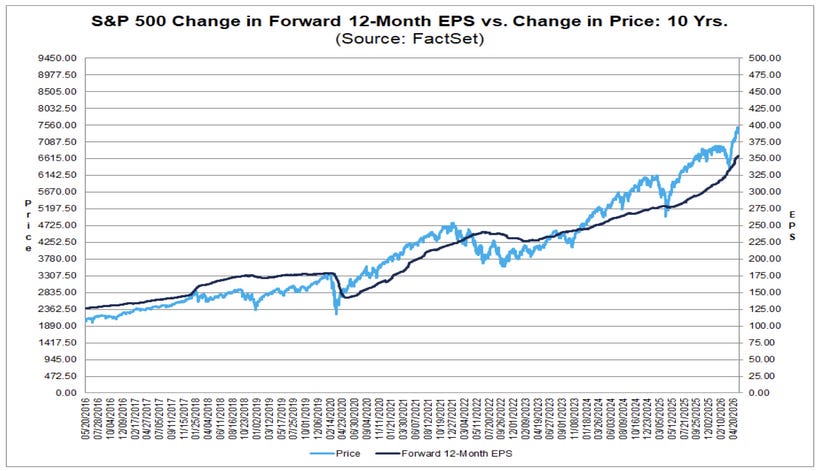
Fundamentally, current market performance continues to be supported by earnings growth, something we have highlighted repeatedly in previous updates.
Even though NVIDIA failed to generate another euphoric upside reaction, aggregate earnings growth across the index still stands near +28%.
Despite tighter financial conditions, elevated rates, and increasingly fragmented global macro dynamics, corporate earnings continue to provide meaningful support for equities.
And for now, that remains the anchor underneath the market.
Institutional Positioning
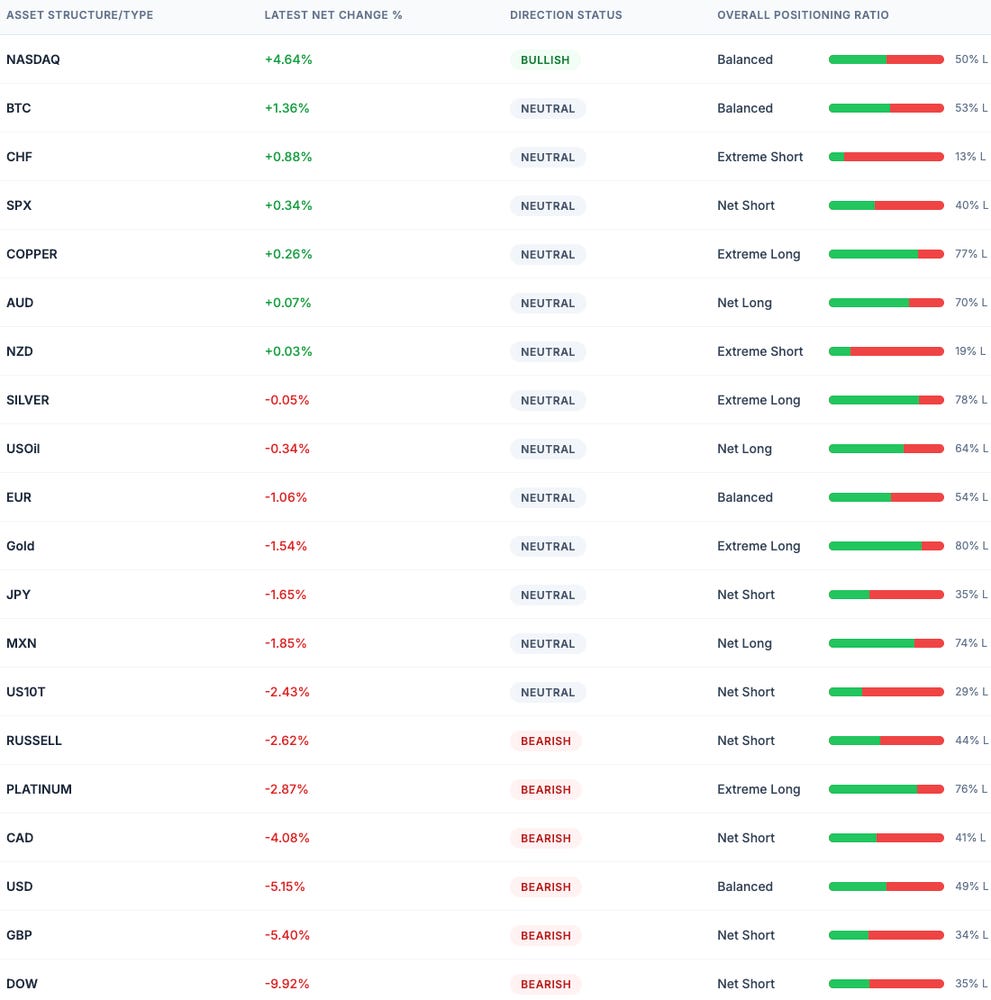
Before turning to this week’s outlook, below is an overview of recent positioning shifts across major asset classes, based on our proprietary Gauch Research COT Visualizer.
Outlook
Upcoming News
AU CPI
RBNZ Cash Rate
US Core PCE Price Index
US GDP
CA GDP
Wishing you a successful week ahead,
David Gauch - Founder, Gauch Research