
Alpha Bets - Part I
A Luxury Compounder in Disguise

Welcome to the first edition of Alpha Bets, a new series where we break down individual stocks and the investment story behind them.
Today we’re starting with a company almost everyone knows, not because of its financials, but because of what it represents.
Ferrari ($RACE) is often seen as just another automaker. But once you look at the numbers and the business model, it becomes clear:
This is not a car company.
It is a luxury brand that happens to sell cars.
The Core Model: Scarcity by Design
Ferrari’s strategy is simple:
Demand must always exceed supply.
The company deliberately limits production, even though it could sell more vehicles. The goal is not volume. The goal is value per client.
This controlled scarcity creates:
Long waiting lists
Strong pricing power
High resale values
Persistent exclusivity
Ferrari does not compete with Ford or Volkswagen.
Economically, it behaves far more like Hermès or LVMH.
Where the Money Really Comes From
Cars are the core product, but margins are driven by mix and customization.
A Ferrari is rarely sold “base spec.”
Clients add:
Custom paint finishes
Unique interiors
Performance upgrades
Bespoke elements
These options carry exceptionally high margins and significantly increase revenue per vehicle.
Beyond that, Ferrari benefits from:
High-margin after-sales services
Spare parts
Licensing and brand partnerships
Formula 1 exposure
The ecosystem reinforces the brand, and the brand reinforces pricing power.
Financial Profile: Luxury Economics
The numbers confirm the thesis.
Growth
Revenue: $8.07B
5Y Revenue Growth: 15.3%
Expected EPS Growth: 10.0%
Profitability
EBIT Margin: 29.8%
Net Margin: 22.3%
ROE: 43.4%
Most automakers operate with single-digit operating margins.
Ferrari generates luxury-level returns.
Cash Flow & Balance Sheet
Debt/Equity: 0.76
Current Ratio: 2.3
This is not a capital-destroying industrial business.
It is a high-return brand platform.
Valuation: Premium for a Reason?
Ferrari trades at:
P/E: 37.5
Forward P/E: 30.4
EV/EBITDA: 22.9
P/FCF: 32.4
Expensive compared to traditional automakers.
But the comparison may be wrong.
The market is not assigning an auto multiple.
It is assigning a luxury multiple.
The real debate is not whether Ferrari is cheap.
The debate is whether Ferrari deserves to be valued like a long-term luxury compounder.
Growth Drivers
Ferrari still has multiple levers:
Price increases
More premium model mix
Limited editions
Hybrid and upcoming electric models
Growth is driven more by value per car than units sold.
Order books often extend years ahead, giving strong revenue visibility and reducing cyclicality relative to mass-market peers.
Key Risks
Premium valuation leaves little room for error
Electrification could challenge brand identity
Ultra-luxury demand depends on global wealth conditions
Ferrari is not immune to cycles, but it is structurally more insulated than traditional manufacturers.
Investment Question
Ferrari combines:
Scarcity
Brand power
Pricing strength
Industry-leading margins
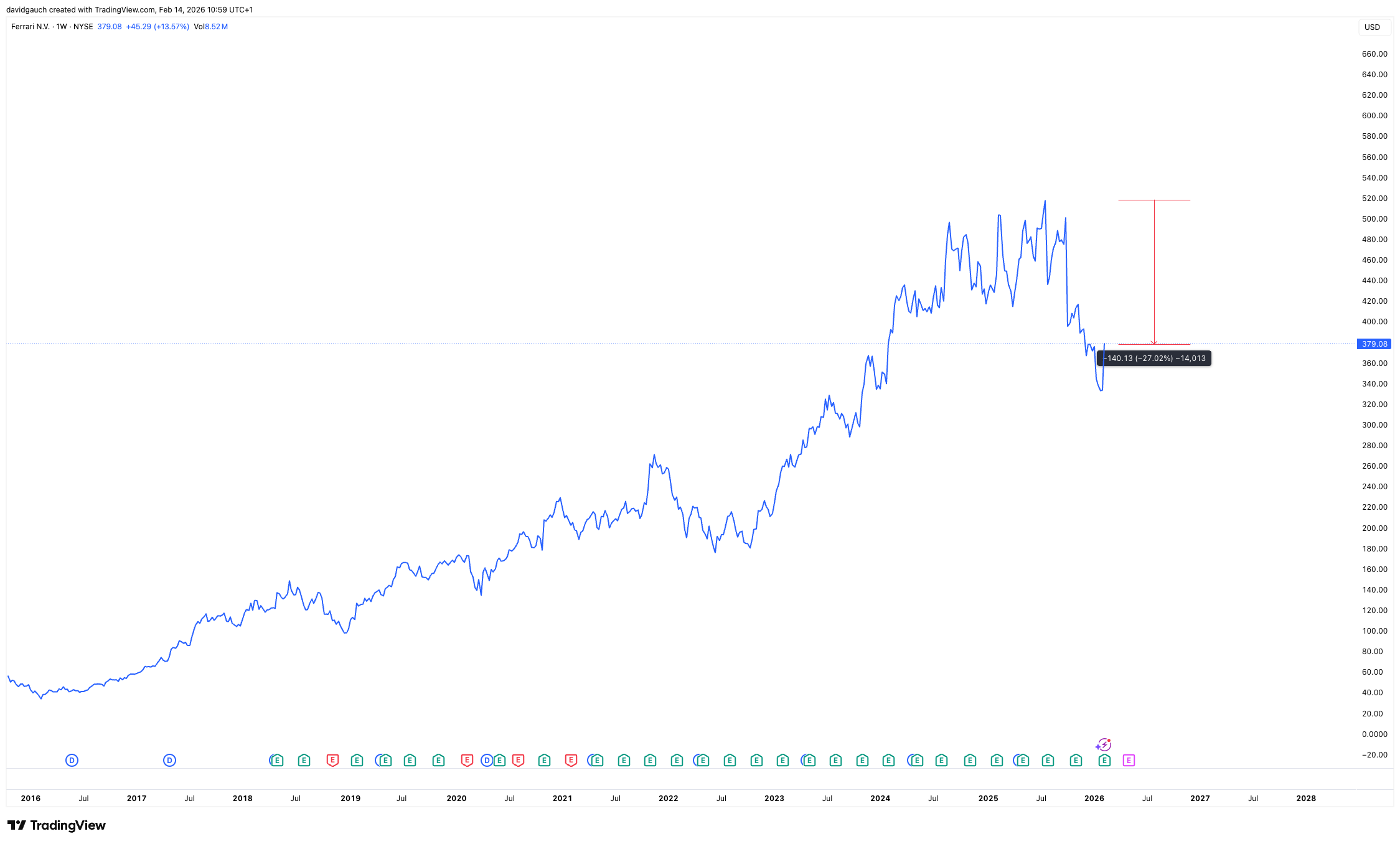
In my view, Ferrari could offer attractive diversification for a global portfolio, especially with the stock trading around 27% below its previous all-time high.
As always, this is not financial advice. The goal of Alpha Bets is to share ideas, frameworks, and investment theses, not to provide buy or sell recommendations. Every investor should do their own research and make decisions based on their personal risk tolerance, time horizon, and financial situation.
P.S. If you own $RACE, you can tell your friends you own Ferrari.
Just not one in your garage.
David Gauch
Founder, Gauch Research